
How Long Does a Securities Class Action Lawsuit Take?
June 23, 2026 | Featured
Author: Yael Nathanson, Of Counsel, Bronstein, Gewirtz & Grossman, LLC
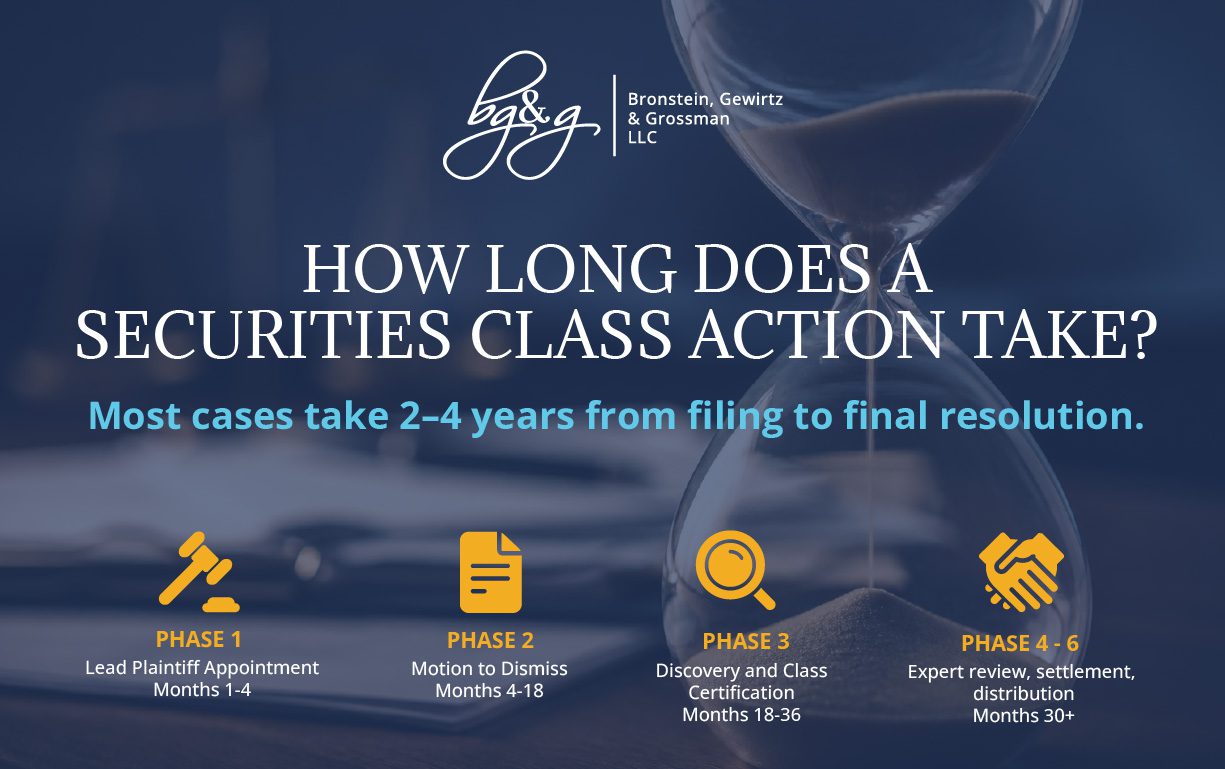
Quick Answer: Most securities class action lawsuits take two to four years from filing to resolution. The process moves through six phases: Lead Plaintiff appointment, motion to dismiss, discovery and class certification, expert analysis, settlement negotiations and court approval, and claims processing and distribution. Ordinary class members take no action during litigation — only the Lead Plaintiff participates actively.
Please note: Every case is different. Actual timelines will vary depending on the complexity of the litigation, court schedules, and how the case develops. The timeline below is a general illustration only and should not be relied upon as a prediction of any specific outcome or duration.
In This Article:
- Phase 1: Filing and Lead Plaintiff Appointment (Months 1–4)
- Phase 2: Amended Complaint and Motion to Dismiss (Months 4–18)
- Phase 3: Discovery and Class Certification (Months 18–36)
- Phase 4: Expert Analysis and Pre-Trial (Months 30–48)
- Phase 5: Settlement Negotiations and Court Approval (Months 36–54)
- Phase 6: Claims Processing and Distribution (6–18 Months Post-Approval)
- Frequently Asked Questions
Phase 1: Filing and Lead Plaintiff Appointment (Months 1–4)
The case begins when a law firm files the initial complaint. From that point, federal law requires a public notice within 20 days, followed by a 60-day window for investors to apply for Lead Plaintiff — the court-appointed representative who will direct the litigation on behalf of all class members.
Key milestones in Phase 1:
- Day 1: Initial complaint filed
- Within 20 days: Statutory notice published; 60-day Lead Plaintiff window opens
- Day 60: Lead Plaintiff application deadline
- Months 3–4: Court appoints Lead Plaintiff and approves Lead Counsel
What investors should do in Phase 1:
If you have significant losses, contact a securities attorney immediately to assess whether you qualify to apply for Lead Plaintiff. The 60-day window is firm and cannot be extended. Check this guide to know if you lost money in a securities fraud case.
Phase 2: Amended Complaint and Motion to Dismiss (Months 4–18)
After Lead Counsel is appointed, attorneys conduct a thorough investigation and file an Amended Complaint with detailed fraud allegations. Defendants almost always respond with a Motion to Dismiss, arguing the complaint fails to meet the PSLRA’s heightened pleading standards.
Key milestones in Phase 2:
- Months 4–6: Lead Counsel investigates and files Amended Complaint
- Months 6–8: Defendants file Motion to Dismiss
- Months 8–14: Both sides brief the motion; oral argument may be scheduled
- Months 12–18: Court issues ruling on Motion to Dismiss
Two possible outcomes: If the motion is granted, the case is dismissed (though an appeal or amended complaint may follow). If denied, the case proceeds to discovery — a significant milestone that often accelerates settlement discussions.
Phase 3: Discovery and Class Certification (Months 18–36)
Discovery is the evidence-gathering phase, during which both sides exchange documents, take depositions of key witnesses, and build their factual record. Simultaneously, plaintiffs file a Motion for Class Certification to formally establish that the case can proceed as a class action on behalf of all affected investors.
Key milestones in Phase 3:
- Months 18–24: Document production — often millions of pages reviewed by both sides
- Months 20–28: Depositions of executives, employees, and other key witnesses
- Months 22–30: Motion for Class Certification filed and briefed
- Months 28–36: Court rules on class certification
Phase 4: Expert Analysis and Pre-Trial (Months 30–48)
Securities fraud cases require expert testimony to establish “loss causation” — how much of the stock’s decline was caused by the alleged fraud versus unrelated market or industry factors. This economic analysis is often the most technically complex and contested part of the litigation.
Key milestones in Phase 4:
- Months 30–38: Plaintiffs’ and defendants’ economic experts prepare reports on loss causation and damages
- Months 36–44: Expert depositions; Daubert motions challenging expert qualifications and methods
- Months 40–48: Summary judgment motions; pre-trial briefing and motions in limine
As trial approaches, the combined pressure of litigation costs, reputational exposure, and trial uncertainty drives the vast majority of cases toward settlement.
Phase 5: Settlement Negotiations and Court Approval (Months 36–54)
The vast majority of securities class actions settle before trial. Once a settlement agreement is reached, it must go through a formal court approval process before any money is distributed to class members.
Key milestones in Phase 5:
- Settlement reached: Parties agree on a settlement amount and plan of allocation
- Preliminary approval: Court reviews and provisionally approves the settlement
- Class notice: All potential class members notified by mail or publication
- Objection and opt-out period: Class members may object or exclude themselves
- Fairness hearing: Federal judge reviews objections and approves or rejects the settlement
- Final approval order: Settlement becomes binding; this entire process typically takes 4–6 months after agreement is reached
Read more on how securities class action settlements work.
Phase 6: Claims Processing and Distribution (6–18 Months Post-Approval)
After final court approval, a settlement administrator processes all submitted claim forms, verifies transaction documentation, calculates each claimant’s recognized loss under the plan of allocation, and distributes payments. This is the phase where eligible investors actually receive their checks.
Key milestones in Phase 6:
- Claim deadline: Typically 30–90 days after final approval; missing this date forfeits your recovery
- Claims processing: Administrator reviews and verifies all submitted claims — can take several months for large classes
- Distribution: Payments issued to eligible claimants; depending on class size, the full process takes 6–18 months after final approval
Important: You will not be paid automatically. Many investors never receive settlement money because they fail to file a claim before the deadline, even if they are otherwise eligible.
Frequently Asked Questions
Can a case settle faster than two to four years?
Yes. Some cases settle within one to two years when evidence of fraud is very strong, when defendants want to avoid prolonged reputational damage, or when a regulatory investigation runs parallel to the litigation and accelerates the factual record.
Do I need to do anything during the litigation as a class member?
For ordinary class members, virtually nothing. You simply wait for a settlement notice, then file a claim form with your transaction documentation before the deadline. The Lead Plaintiff does the active work of directing the case on behalf of all class members.
Is there any way to get my money faster during a securities class action?
There is no way to access your settlement share before the case resolves. However, if your losses are substantial, consult a financial advisor about options independent of the litigation. The contingency fee structure means you have no ongoing financial obligation to the firm during the case.
Can the case end without any recovery?
Yes. Cases can be dismissed at the Motion to Dismiss stage, denied class certification, or lost at trial. This is why the contingency fee model exists — law firms bear the financial risk of litigation alongside investors. If there is no recovery, you owe nothing.
What percentage of securities class actions go to trial?
Very few — according to data from the Stanford Securities Class Action Clearinghouse, only about 0.4% of core federal securities class actions filed between 1997 and 2022 went to trial. The vast majority are resolved before trial, either through settlement or dismissal, typically after expert analysis and other pre-trial proceedings give both sides a clearer picture of litigation risk, potential damages, and the cost of proceeding. Settlement provides greater certainty for both the defendant and the investor class.
How will I know when the case settles and a claim form is available?
The settlement administrator sends notice by mail or email to all potential class members identified from brokerage and transfer agent records. You can also monitor active cases and settlement notices at bgandg.com/cases. If you held shares through a broker, your broker may also forward the notice on behalf of the administrator.
Does the timeline change if there is a parallel SEC investigation?
A parallel SEC investigation can both accelerate and complicate a private class action. On one hand, SEC subpoenas and enforcement findings can generate evidence that strengthens the plaintiffs’ case and increases pressure on defendants to settle. On the other hand, defendants may seek a stay of the private litigation while the SEC investigation is ongoing, which can add months to the timeline.
Get a Free Case Review from Bronstein, Gewirtz & Grossman, LLC
If you believe you have a securities or consumer claim, our attorneys can help — at no cost to you.
Call 917-590-0911 or visit bgandg.com to submit your information for a free consultation.
Bronstein, Gewirtz & Grossman, LLC (BG&G) is a nationally recognized plaintiff’s law firm with nearly 30 years of experience representing investors and consumers in securities fraud and class action litigation. Ranked among the top securities class action firms in the country by ISS Securities Class Action Services, BG&G has recovered hundreds of millions of dollars for clients nationwide. The firm handles securities class action cases on a fully contingent basis.
Learn more about our firm.
Last Updated on June 24, 2026 by Yael Nathanson